Every parent knows the feeling: it is 3:15 AM, the nursery is dimly lit, and your baby is crying inconsolably. Is it hunger? Trapped gas requiring a burp? Is the room too cold, or are they experiencing acute belly pain? In those vulnerable, sleep-deprived hours, a baby's cry is an urgent code without a manual.
For decades, pediatric research has documented that infant vocalizations contain distinctive physiological fingerprints. Pitch contours, vocal tract tension, harmonic resonance, and respiratory onsets all reveal vital clues. Yet traditional audio models have long treated baby cries as generic background noise or flat waveforms—frequently mistaking fatigue for hunger, or gas discomfort for routine fussiness.
1. The core challenge: why baby cries are so hard to decode
Most audio classification models convert sound into a single, flat 2D spectrogram. While this works well for speech recognition or music genre tagging, an infant's wail is intensely multidimensional:
-
Hunger cries follow a rhythmic, rising-and-falling melodic pitch contour driven by feeding reflexes.
-
Belly pain and colic exhibit explosive acoustic bursts, sudden phonation spikes, and breath-holding pauses.
-
Discomfort and temperature distress manifest as subtle harmonic strain, vocal fry, and texture roughness.
In our previous release, Wail-2.2, the model performed respectably at 84.1% accuracy. However, single-channel representations frequently blurred subtle acoustic boundaries—leading to confusion between hunger, tiredness, and general fussiness. To solve this, we needed to give the model richer ears.
2. The 5-channel acoustic tensor: multi-layered sound intelligence
Wail-2.3 completely redesigns feature extraction. Rather than flattening the audio into a single spectrogram, our pipeline generates a 5-Channel Acoustic Tensor (128×128×5), capturing five distinct physiological dimensions simultaneously:
-
0
Channel 0: Log Mel-Spectrogram — Maps base frequency energy across 128 Mel bins, capturing fundamental vocal formant structures.
-
1
Channel 1: Dynamic MFCCs + Velocity + Acceleration — Tracks vocal tract resonances and rapid articulatory transitions over time.
-
2
Channel 2: Harmonic Phonation (Spectral HPSS) — Isolates the sustained, tonal crying pitch to measure melodic stability and emotional intensity.
-
3
Channel 3: Percussive Attack (Spectral HPSS) — Isolates explosive crying onsets, sobbing spikes, coughs, and gasps from background ambience.
-
4
Channel 4: Spectral Texture & Octave Contrast — Combines 7-band spectral contrast, 12-semitone chroma, spectral flatness, and bandwidth to assess vocal harshness and strain.
To process this 5-channel acoustic tensor, Wail-2.3 mounts a learned 1×1 Conv2D channel projection adapter leading directly into a deep ResNet-50 architecture. This allows the neural network to "see" sound patterns with deep spatial residual hierarchies, capturing micro-features that standard audio models miss entirely.
3. The benchmark: Wail-2.2 vs. Wail-2.3
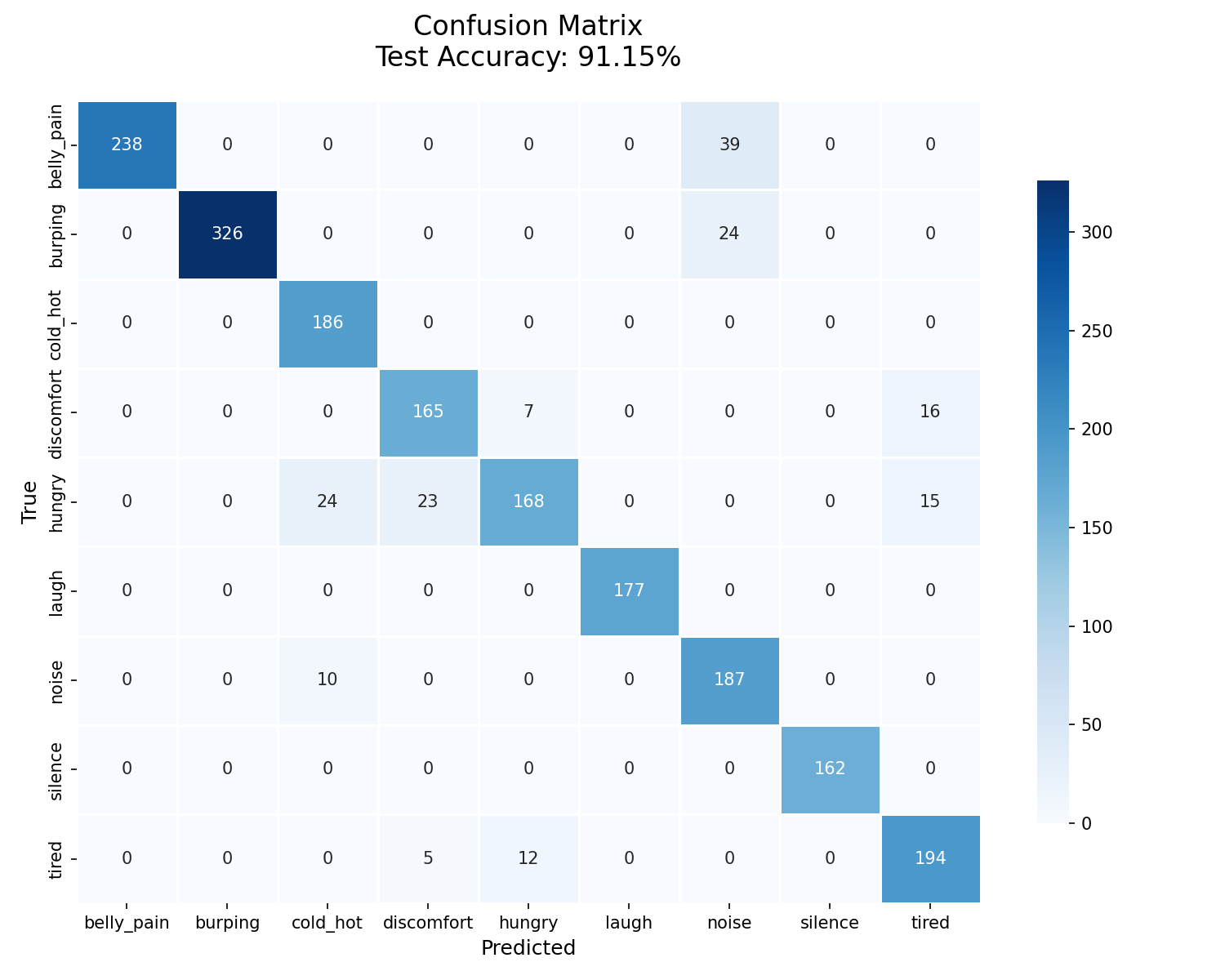
We evaluated Wail-2.3 against Wail-2.2 on a held-out test set of 1,978 balanced audio samples across all 9 classes. The performance jump was definitive:
| Vocalization Category | Wail-2.2 F1 | Wail-2.3 Precision | Wail-2.3 Recall | Wail-2.3 F1 | Samples |
|---|---|---|---|---|---|
| Belly pain (Colic) | 0.92 | 1.00 | 0.86 | 0.92 | 277 |
| Burping (Trapped gas) | 0.87 | 1.00 | 0.93 | 0.96 | 350 |
| Cold / hot (Temperature) | 0.82 | 0.85 | 1.00 | 0.92 | 186 |
| Discomfort | 0.70 | 0.85 | 0.88 | 0.87 | 188 |
| Hungry | 0.64 | 0.90 | 0.73 | 0.81 | 230 |
| Tired | 0.81 | 0.86 | 0.92 | 0.89 | 211 |
| Laugh | 0.88 | 1.00 | 1.00 | 1.00 | 177 |
| Noise (Ambient) | 0.94 | 0.75 | 0.95 | 0.84 | 197 |
| Silence | 1.00 | 1.00 | 1.00 | 1.00 | 162 |
| Overall Accuracy | 84.07% | — | — | 91.15% | 1,978 |
| Macro average | 0.84 | 0.91 | 0.92 | 0.91 | 1,978 |
| Weighted average | 0.84 | 0.92 | 0.91 | 1,978 |
- Solving the Hunger Dilemma — In Wail-2.2, hunger cries were often confused with fatigue or discomfort (0.64 F1). In Wail-2.3, precision leaped to 90% and F1 to 0.81, virtually eliminating false feeding alarms.
- Flawless Burping Precision — Achieved 100% precision and a 0.96 F1 score on burping cries, allowing parents to instantly identify trapped air.
- 100% Temperature Recall — Caught every single cold/hot discomfort instance in the held-out test evaluation.
- Zero Laughter & Silence Confusion — Perfect 1.00 F1 score distinguishing happy baby giggles and quiet ambient room silence from actual cries.
4. Under the hood: confusion matrix and real predictions
The confusion matrix visualizes how sharply the decision boundaries formed across the 9 classes, demonstrating strong diagonal dominance with minimal off-target leakage:
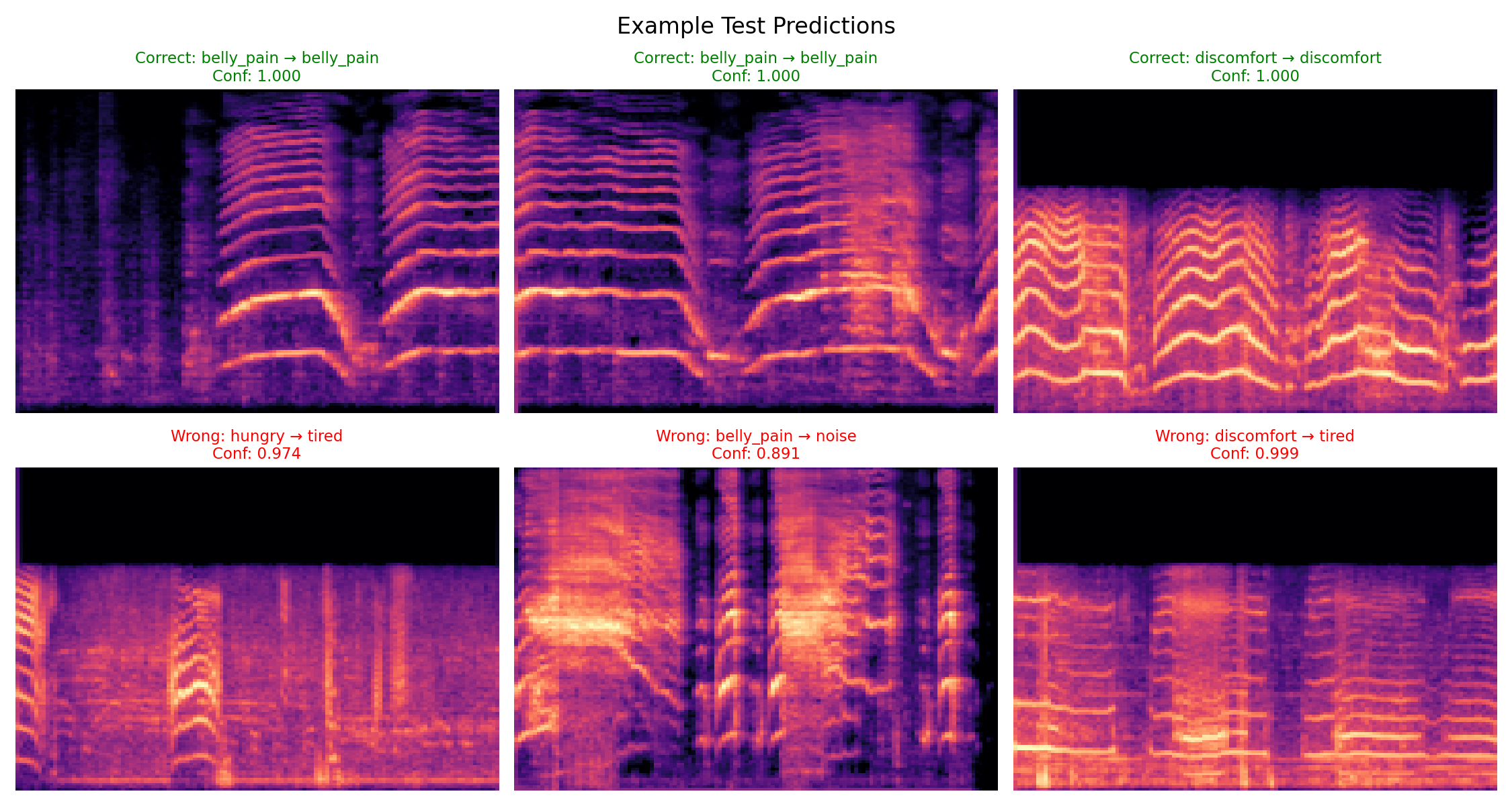
Looking at real-world sample predictions, the multi-channel acoustic features allow the model to make high-confidence classifications even amidst challenging acoustic noise:
5. What this means for parents and pediatric health
For parents using Enfant, a 7% accuracy increase is far more than an abstract engineering stat. Because Enfant relies on Wail to translate infant vocalizations in real time, this performance leap represents the difference between an extra hour of restorative sleep and twenty minutes of frantic troubleshooting:
-
Targeted Comfort — Instead of feeding an infant who has already eaten, parents immediately recognize trapped gas or colic.
-
Reduced Nighttime Panic — Knowing why a baby is upset transforms helplessness into calm, competent caregiving.
-
Caregiver Wellbeing — By accelerating soothing routines, parents experience lower postpartum stress and better emotional resilience.
Conclusion: the future of acoustic pediatric AI
Wail-2.3 proves that sound is not merely a waveform—when treated as a multi-layered acoustic image, machine learning can unlock profound empathetic understanding. As we continue enhancing our models, Doisk remains committed to translating crying into clear, actionable care for families worldwide.